StatCounter

Sunday, March 21, 2010

iPods and Healthcare Reform

In the late 1990s, an engineer named Tony Fadell came up with the idea of a hard drive-based MP3 player coupled with a Napster-like music store to complement it. He shopped the idea around to several companies but was turned down at all of them except for one. That company was Apple.

After modifying, improving, changing Fadell's original concept, Apple released a new device in 2001 they called an iPod.

The initial reaction on Slashdot, a prominent tech site gave this one sentence review:
"No wireless. Less space than a nomad. Lame."
At $399, it was also $150 more than a comparable $249 Nomad Jukebox. It wasn't compatible with Windows PC computers, just Macs which had a small market share at the time. You couldn't replace the battery. It had no FM radio. Many critics predicted it would flop.

And yet somehow the iPod went on to take over the music player industry. It now has about a 75% share of the market and has sold over 225 million units and counting.

It helped re-establish Apple as a top electronics brand, and paved the way for its subsequent successes with the iPhone and now the upcoming iPad.

The original iPod wasn't perfect. It was a start of something new, and it has improved gradually but continuously since then. But if Apple had listened to the naysayers and pundits at the time, none of this would have happened.

So I believe it will be with the current healthcare reform bill. It is not perfect, but there never could be such a thing as a perfect healthcare reform bill anyways. Those who criticize it and want it to fail because it doesn't have everything they want are short-sighted and unrealistic.

These are the same kind of people who couldn't see the potential in a little electronic music player, only the flaws.

If healthcare reform fails to pass now, it will be a loooonnnng time before any legislator attempts to try this again. And frankly, we can't afford to wait as the current system continues to crumble and cost everybody more and more money for worse and worse care.

As of now, I don't know if it will get the required votes or not, but I hope it passes. And if it does, I think it can be shaped and molded and upgraded over time to become a even better healthcare system.

Wednesday, March 10, 2010

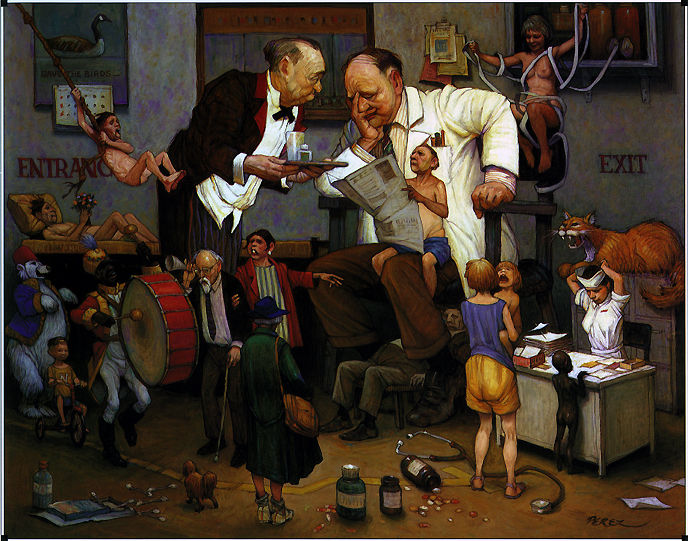
The Family Practitioner


Found this illustration via The Examining Room of Dr. Charles. I'd say it captures the feel of most family doctors' offices just right except that the tape the woman sitting behind the doctor is tangled up in should be red instead of white.

For other depictions of various medical specialties, go to this exhibition on the art of Jose Perez.

Tuesday, March 09, 2010

A Top 50 Blog!

My blog is number 35 on this list which came out a while ago and is in no particular order. Amazing, considering how infrequently I post. But I am more about quality than quantity. That is, after all, why I left seeing 24+ patients a day and now see about 4-6 patients/day in my little micropractice.

Speaking of Top 50 blogs, I notice over on the excellent DB's Medical Rants site that he is posting his monthly workout tally on his blog, I guess to hold himself accountable for his exercise regimen. Likewise, over the past few years, I have come to the realization that I need to be pushed to exercise.

Like many of you, I had my gym membership that got used for the first few months, only to languish and fall to the wayside as my schedule got busy and motivation waned.

Then a few years ago, my wife showed me this newspaper article about a trainer that can help you dunk. I thought, why not give it a try? So I called the trainer up and he has been training me ever since. I haven't dunked a basketball yet (at least not on a 10 foot rim), but I have touched the rim, something I haven't done since college. In case you're wondering, I'm only 5'9".

But I am convinced that if I keep at it, I will eventually achieve my goal and dunk. Just like I was able to establish my solo micropractice. But I still need some coaching to help get me where I want to be.

That is what we can all use sometimes, whether is is losing weight, eating better, managing time, etc. A little coaching. And a willingness to work at it.

Monday, March 08, 2010

The 7 Doctors and the Patient

Once upon a time, there were six doctors in a hospital. One day the admission clerk told them, "Hey, there is a patient in the hospital today."

They had no idea why the patient was in the hospital. They decided, "Even though we have no old chart, let us go and examine the patient anyway." All of them went to where the patient was. Every one of them touched the patient.


"Hey, this is atopic dermatitis," said the first doctor who touched his skin, for he was a dermatologist.

"Oh, no! it is acute lumbago," said the second doctor who touched the back, for he was an orthopedic surgeon.

"Oh, no! it is paroxysmal tachycardia," said the third doctor who touched the chest of the patient, for he was a cardiologist.

"It is temporomandibular joint syndrome" said the fourth doctor who touched the jaw of the patient, for he was an otolaryngologist.

"It is spastic colitis," said the fifth doctor who touched the belly of the patient, for he was a gastroenterologist.

"No, it's lacrimal duct obstruction," said the sixth doctor who touched a tear from the eye of the patient, for he was a ophthalmologist.

They began to argue about the patient and every one of them insisted that he was right. It looked like they were getting agitated.

A seventh doctor was passing by and she saw this. She stopped and asked them, "What is the matter?" They said, "We cannot agree on the patient's diagnosis." Each one of them told what he thought the patient had.

The seventh doctor took a good look at the patient and said, "I know this man. This is Joe, and he is having an acute stress reaction because he just lost his job and his wife is being treated for breast cancer." And she shook his hand, offered some reassurance and made Joe feel better, for she was his family doctor.

Based on a well known story about an elephant.

Sunday, March 07, 2010

3 hours vs 36 minutes

That's the difference between how much time my patients get with me per year vs a typical primary care practice, using the same kind of calculation from this article posted at kevinmd.com found by way of the Ideal Medical Practices blog.

Assuming 2 weeks of vacation a year and a patient panel of 500:
50 weeks a year x 30 hours per week divided by 500 patients = 3 hours.

Compare this to the 36 minutes per year patients get in a typical primary care doctor's office with a patient panel of 2500.

"I can see you today."
"I can see you on time."
"We can take all the time you want and need."

This is the mantra of the Ideal Medical Practice model.

Saturday, March 06, 2010

A Different Hat

I am currently in Sacramento wearing my California Academy of Family Physicians (CAFP) delegate hat at the Annual Congress of Delegates. Lots of civic-minded, concerned and caring family doctors doing a relatively thankless job. None of us get paid for this. Most family doctors in the state don't even know what we are doing at this meeting or that there is a meeting. But we are just trying to make a difference.

Dr. Lori Heim, president of the American Academy of Family Physicians, was the guest speaker and she gave a quick update of how she sees the current healthcare reform going in Washington, DC. She gives the current bill a 50-60 percent chance of making it into law.

She noted how much has changed since 1 year ago when everyone talked about the importance of healthcare reform and how cooperative and bipartisan the initial talk had been. Fast forward to now and, even after 20+ years of health policy debate and study, it has reverted back to being partisan in the ugliest way.

She outlined AAFP's priorities for health care reform:
  • Expand coverage with minimum benefits package
  • Increase access/increase primary care workforce
  • Insurance market reform
  • Tort reform
Massachusetts demonstrated what happens when you increase coverage but don't have enough primary care doctors. Insurance does not equal access. 

To produce more family physicians, we need to resolve the "income differential" between primary care doctors and specialists, many of whom make 2-3 times more than FPs. There is simply no way to increase the number of family physicians when medical students see how much more they can make by going into a specialty instead.

CMS (Centers for Medicare and Medicaid Services) is looking into adjusting overvalued and undervalued CPT codes and has been criticized by specialists who see a loss of income. To counteract this, Heim said we need to write to our legislators to voice support for CMS's efforts.

For instance, some cardiologists claimed that eliminating the consult code would cause them to lose so much income that they would have to stop practicing cardiology and go back to primary care.

"That's okay, I said. They can come to my office and I'll teach them how to be a primary care doctor. Let's see how they like that," Heim said.

She pointed out that we need to bring Medicaid reimbursements up to at least the level of Medicare. "When you're losing money on visits, increasing the volume doesn't help."

Administrative simplification also needs to happen to relieve the crushing red tape and bureaucracy that every primary care doctor has to deal with.

Dr. Heim listed some of the major highlights of the current proposed legislation:
  • No public option. Instead there will be state by state insurance exchanges.
  • 10% bonus for primary care.
  • 94% of population will be covered under the Senate plan.
  • Establishment of a Medicare Advisory Board.
  • Accountable Care Organizations.
  • Dependent coverage up to age 26.
Heim acknowledged that the current bill is not perfect but that "it has a lot more good than bad," adding that healthcare reform will be an ongoing process.

-----------

I will be meeting with my state assemblymember and state senator on Monday to lobby/discuss CAFP's position on various pieces of healthcare legislation making its way through the state Capitol. We all complain about how bad the system is. This is my chance to try to do something about it.

If you want to do something about healthcare reform, you can help by:

  • Voting
  • Writing to your legislators
  • Writing a letter to the editor of your local paper
  • Asking your patients to write to their legislators or local papers
  • Posting/linking/tweeting/blogging about healthcare reform
  • Contributing to FP-PAC, CAFP's Political Action Committee (or your own state's PAC) or FamMedPac, AAFP's PAC so that someone will speak to the legislators for you besides the lobbyists for the insurance and drug companies.

As Dr. Tom Bent, CAFP's president said, "We no longer have the luxury of hiding in our exam rooms, or of just being a good doctor. We have to learn how to talk to the Rotary Club, legislators, the news media and the public."

Blogging's good, too, I assume.

Wednesday, February 24, 2010

A Sign of the Times


Aaron Blackledge, MD, of CarePractice in San Francisco has a message that he would like to share with the public about the current state of the healthcare system.

Being a primary care doctor these days is becoming more and more discouraging with the current payment system and insurance hassles, so much so that doctors are working less hours as noted in this Washington Post article:

Average hours dropped from about 55 to 51 hours per week from 1996 to 2008, according to the analysis, appearing in Wednesday's Journal of the American Medical Association.
That's the equivalent of losing 36,000 doctors in a decade, according to the researchers. And it raises policy questions amid a looming primary care doctor shortage and Congress considering an expansion of health insurance coverage that would mean more patients.
It's not hard to figure out why.
The overall decrease in hours coincided with a 25 percent decline in pay for doctors' services, adjusted for inflation. And when the researchers looked closely at U.S. cities with the lowest and highest doctor fees, they found doctors working shorter hours in the low-fee cities and longer hours in the high-fee cities.
Unless there is meaningful healthcare reform soon, things will probably get worse before they get better.