StatCounter

Wednesday, August 13, 2008

Gone Cruising

Image

One common question that comes up with doctors looking into doing an IMP/solo model practice is: how do you take vacation?

This is a problem encountered by all solo physicians, not just those doing the IMP model. For myself, when I first went solo 4+ years ago, I didn't know any FPs in the local community and didn't know who to ask for coverage. So that first summer, I took my own call when my family went on vacation to Banff, Canada for a week. Since I was only seeing about 5 patients a week at that time, I figured no one would even really notice that I was even gone, especially when they could still reach me by phone and e-mail. And no one did. I scheduled patients for physicals the following week while sightseeing, just as if I was back in my own office.

Later on, I met some other solo family physicians through the local hospital medical staff meetings, and asked if they would be interested in doing reciprocal coverage, where I would cover them if they would cover me. It has worked out so far. It helps that our practices generally take the same insurance plans as each other. It also helps that:
1) I have less than 1000 patients so that means fewer calls.
2) My patient population tends to be younger so again that means healthier patients and fewer calls.
3) I still continue to take cellphone calls and e-mail so I can take care of issues quickly and easily that the covering physician might take longer to handle.

Having no employees the first few years of my practice meant not having to worry about paying for their services when I was away. I now have a part-time biller, but she can do her work even when I am away.

This coverage system has allowed me to travel with my family to Palm Springs, Yosemite, Walt Disney World in Orlando, Bar Harbor in Maine, New York City. This summer I have taken my longest vacation yet of 2 weeks. In fact, I am still on vacation, writing this from a Mediterranean cruise ship en route from Sicily to Naples.

While there is Internet access available, it is slow and expensive, so I have not been able to receive and respond to e-mail as quickly as I usually do. Also, I have no cellphone access, so that has resulted in more isolation, which is good for vacationing, but not so good for continuity of care. I know I should be grateful for being cut off from work. There is a tendency among many physicians (me included) to never let go of work, which I am always telling patients that they have to do to reduce stress. I should follow my own advice.

I know there are other solo physicians who take their own call whenever they go on vacation, without arranging for any kind of coverage. I think it depends on how far you go, and what your patient panel is like. If you are a doctor in a rural area with no other primary care physician nearby for coverage, that may be your only option. Hiring a locums doctor is another solution, but I think running a solo IMP model, even temporarily, might freak out your usual locums doctor who is used to the usual set up of having someone else answer the phones, do the scheduling and give the shots.

Since there seems to be a growing number of doctors interested in the IMP model but who are not ready to make the "leap" themselves yet, I think it would be ideal and mutually beneficial for a pre-IMP doctor to do locums coverage for an IMP doctor just to get their feet wet, and at the same time, help out an solo IMP doctor who might not otherwise feel confident about leaving their practice for much-needed R&R time. Something like a Craig's List for IMPs.

Anyways, I hope that all primary care physicians get a chance to take some time to rest, relax and recharge this summer.

Ciao bella!

Friday, August 01, 2008

Comic-con Relief

OK, I meant to post these last week when I went to Comic-con. Better late than never.

Image

Image

Image

Image

Sick, but funny. Trust me, I'm a doctor.

Sunday, June 22, 2008

Old Fashioned Touch

From The Olympian in Washington State: "Old-fashioned touch: Micropractice helps doctor humanize modern medicine"
Dr. Marius Laumans strives to run an old-fashioned medical practice with modern-day conveniences.

Need a same-day appointment? Patients can go to his Web site, check his availability and schedule one.

Wondering if an over-the-counter allergy drug could mix poorly with prescription medication? All of Laumans' patients have his cell phone number and e-mail address and are encouraged to use them anytime.

Too sick with a stomach bug to get out of bed and drive to his office? Not to worry, he makes house calls, too.

"Thirty years ago, this was what a regular practice looked like," Laumans said.

The 34-year-old family physician is one of a growing number of doctors who are opting to go solo - without the support of receptionists, nurses, medical assistants, billing clerks and cleaning staff.

Dr. Laumans is indeed part of a growing movement of IMP (Ideal Medical Practice) doctors that seeks to improve quality of care as well as quality of life for patients and physicians alike. However, this article perpetuates the old concept of "micropractices" being completely solo-solo operations. Many IMPs start out without any employees, then add staff later as the practice grows.

And there aren't 500 micropractices/IMPs in the country...yet. But hopefully there will be. To find an IMP, go to http://www.impmap.com.

Friday, June 20, 2008

The Hopeful Future of Medicine

Image

IMP Camp 2008 is underway and full of bright-eyed and bushy-tailed (and even tail-deficient) doctors!

From Soma's blog
I had started my medical practice in Manhattan in the summer of 2006. They say if you can make it there you can make it anywhere…Oh boy is that true. I started my business before I even knew the existence of the IMP group. I didn’t realize that the same concepts and the similar reasons why I wanted to go into business for myself was why several other physicians all over the country did the same. Most of the topics at the conference are things that I have already been developing in my own business. The spirit of the people is what gives me inspiration to continue what I am doing. Some have been in business longer than I have, some work in areas that are considered to be dead-zones for effective health care. But they continue. They get over the hurdles, take every day one day at a time and remain true to their souls. The magic of this is this is something that you cannot learn in medical school. It already has to be there. And most of the people here have it.

Speaking as one of those "dead-zone" doctors, I agree with Soma's sentiments about the enthusiastic spirit and idealism of the 80+ attendees. We want to save the world, one patient at a time.

IMP Evolution

From the June 2008 issue of Medical Economics, "Small practice evolution: The medical micropractice":
Every so often, a new patient of internist Jean Antonucci in Farmington, ME, looks puzzled when the doctor herself—and not a medical assistant—walks into the waiting room and escorts him to a 125-square-foot room.

In that room, which looks out on pine trees and a stream, Antonucci takes vital signs, asks the patient what's bothering him, diagnoses and treats that problem, and collects the copay. By the time the patient leaves, he realizes that Antonucci is truly a one-woman show.

"I really don't need staff," says Antonucci, who rents the space from another physician. "I'm amazed at how well this method works."

The method is known as a micropractice, and it defies the conventional wisdom of practice management experts who urge doctors to boost their productivity by delegating nonphysician chores. A micropractice doctor typically works without employees in a space that's drastically smaller than what the average soloist has. Such austerity reduces the customary overhead by 40 to 50 percent, thereby lowering the break-even point and enabling micropractitioners to spend more time with fewer patients.

Speaking of evolution, the official name is now "Ideal Medical Practice" or IMP, and not micropractice. That's because you don't have to be solo/small to achieve ideal health care.

Tuesday, May 13, 2008

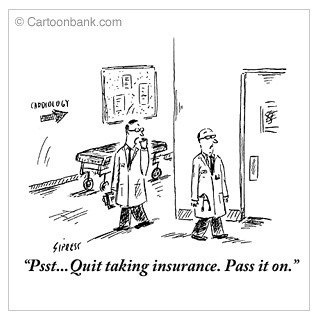
Psst!

Image

From The New Yorker Magazine

Pass it on.

Wednesday, February 13, 2008

Franco is Still Dead

From the NY Times: "Number of US Primary Care Doctors Down".
Fewer American doctors are focusing on primary care, but the decline is being covered by physicians from other countries. The General Accountability Office said Tuesday that as of 2006 there were 22,146 American doctors in residency programs in the United States specializing in primary care.

That was down from 23,801 in 1995, the research arm of Congress told the Senate Health, Education, Labor and Pensions Committee.

''It is troubling to me that the number of Americans pursuing a career in primary care has declined,'' said Sen. Bernie Sanders, I-Vt.

The Senator's solution? Doubling the funds for the National Health Service Corps. That's like trying to get people to buy a Zune by pricing it less than an iPod. Hello? It ain't gonna work with primary care either.

The only way to get more doctors going into primary care is to make the career and lifestyle *more* attractive than going into a specialty. Paying them more and abusing working them less would be a great start.

I'm not holding my breath on this one.