StatCounter

Friday, April 03, 2009

Pre-existing condition of being human

This article by syndicated columnist Ellen Goodman from yesterday's Washington Post gives a nice summary of what ails our current US healthcare non-system: "The Care in Health Care":
I was tickled to hear that the insurance industry is beginning to commence to start to think about lifting bans on the pre-existing conditions that keep a slew of Americans from getting health coverage. This has always been on the deep end of a pretty wacky system.

But there is a pre-existing condition that hasn't garnered nearly as much attention in the health care debate. It's the condition we all share: being a human being. As opposed to, say, being an organism subdivided into parts and scattered over the medical landscape from neurology to podiatry.

The current system makes it hard for people to get care for their whole body, much less their whole self (mind and body). The balance between splitters and lumpers has been tipped to the splitters by a wide margin for some time now.

Consider one of the least secret medical records in the country: the erosion of primary care doctors. A half-century ago, we had an equal number of generalists and specialists. Today there are two specialists for every generalist.

In clear view and with all undeliberate speed, we developed a system that rewards procedures over primary care. As analyst Robert Blendon puts it bluntly, "It's absolutely clear that payment systems have been negotiated that reward specialty time and use of equipment." The incentives tip toward the kind of medicine that is performed with hands, tools and technology over the medicine that is practiced with eyes, ears, and mind.

The average generalist now earns 55 percent less than the average specialist. Many students apply to medical school to connect with and take care of sick people. They graduate to become what one doctor slyly calls "proceduralists." They enter with a strong desire to look after families and exit with a ticket to X-ray femurs.
Read the entire article here.

She gets it. More and more people are finally getting the message that no meaningful healthcare reform will take place without fixing primary care first. And to fix primary care, you need to fix the system so that it will encourage, and not discourage, doctors from going into primary care. Otherwise we will continue to have too many doctors who look at you primarily as a body part rather than a human being.

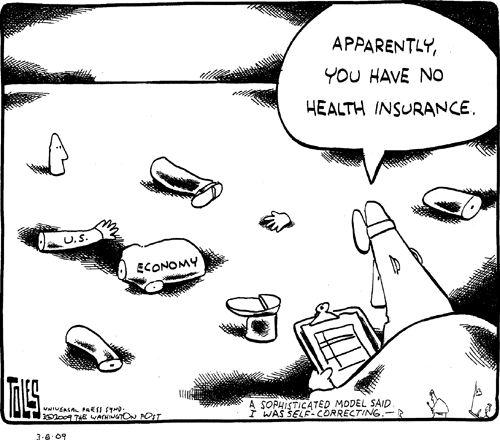
Sunday, March 08, 2009

Saturday, March 07, 2009

Keep The Faith

When I arrived this morning in Sacramento, I wasn't sure why I was here. I am attending the California Academy of Family Physicians 2009 Congress of Delegates. I am one of many family physicians who have come from all over the state. They are leaders in their community, faculty in academic medicine and residency programs, department chairs, chapter presidents.

I am here because I happen to show up at most of the meetings. If you go often enough, you get nominated to be a delegate. This year especially there weren't enough of us coming from the Los Angeles Chapter so they asked for volunteers. At the registration table, my name was not listed as one of the delegates. Maybe I don't belong here.

The guest speaker is Dr. Ted Epperly, the current president of the American Academy of Family Physicians (AAFP). He notes the current national crises (crisises? crisii?) and says that he believes that, after many years of failed attempts, healthcare reform is finally going to take place in 2009 because of a miracle. According to Epperly, that miracle was the election of Barack Obama.

He said that he was at the White House 2 days ago, invited along with representatives from the 3 other primary care specialties (American College of Physicians, American Academy of Pediatricians, American Osteopathic Association) and a host of legislators, insurance representatives and stakeholders. They were part of a White House Health Care Summit there to discuss how to fix what ails our nation's medical non-system.

During the summit, Obama asked for the cooperation and participation from all the interested parties. And when he came to physician participation, he called on Epperly (who was taken by surprise and only had about 20 seconds to speak).

What he said was:
"Speaking on behalf of over 100,000 doctors, we're ready to do our part. We very much believe that we need to expand coverage in this country to everyone, and we need to fix the work force, sir, so that all those patients have a place to go.

We'll roll up our shirtsleeves and do everything possible to make this work. Because it is the right thing to do, and I applaud you and this body for doing this today, to do it this year. And we must do it. Thank you."

Epperly said he feels it was not by accident that Obama chose a family physician to speak for American physicians. It’s because he understands that primary care is broken.

He also said the president made it clear that everyone must be at the table, everyone must listen and everyone must give up a little something. Epperly quoted Victor Fuchs, a noted Stanford economist, as saying US healthcare reform would only come about if there was a war, an economic depression or major civil unrest. (We got 2 out of 3 so far.)

The Patient Centered Medical Home (PCMH) has become more than a model of healthcare, Epperly said. It has become a symbol of a movement to restore healthcare to this country.

Epperly observed that the current healthcare system is totally unsustainable, especially in this recession. Healthcare spending rose to $2.4 trillion in 2008 and is projected to rise to $2.5 trillion in 2009. But Epperly is hopeful that reform will finally take place under the Obama administration. "More has been done in one month than has been done in the past decade as far as healthcare reform," he said. "We can't afford to keep putting it off. President Obama recognizes that if there isn't enough investment in our domestic policy, this country will fall apart."

Epperly also called on family physicians to take a more active role in advocating healthcare reform. "If you're not at the table, you're on the menu," he said. "We family physicians are in the position we are in, not because the work we do is not worth it, but because we didn't step forward when we needed to."

Even though family physicians may feel like they're not getting the respect or the payment that they deserve for their work, Epperly feels Obama recognizes the value of family physicians to care for patients and their community. "Don't lose faith," Epperly said. "It won't be easy, but a better day is coming."

At the end of Epperly's talk, I felt re-energized and motivated, hopeful that our healthcare system can and will change for the better, sooner rather than later. I will continue to try to improve my solo practice using the principles of the PCMH. And while I don't have the charisma, eloquence or leadership of Obama or Epperly, I can blog.

I guess I figured out why I am here in Sacramento after all:

To keep the faith. And to help Save Primary Care.

Tuesday, February 10, 2009

But Is It Covered By My Insurance?

An ad for a longevity-enhancing product in today's Washington Post:
INDICATIONS AND USAGE: Marriage is the therapy of choice for treatment of the condition of being unmarried. Marriage is approved to manage the dread of growing old alone and missing the opportunity to have dinner every night with a special someone, but without talking. Clinical trials indicate that marriage is recommended if you have found either a true soul mate or someone who has an excellent 401(k).

"It may also cause children."!!! Well, that explains how the kids got here.

At least it's probably more effective than multivitamins at extending lifespan.

Friday, January 23, 2009

Getting There From Here

Dr. Atul Gawande has a thoughtful article in the New Yorker about the transformation of healthcare in other countries and how it might happen here in the US. He feels that Massachussetts' new law that requires everyone to get health insurance is a good but imperfect start:
For all that, the majority of state residents would not go back to the old system. I’m among them. For years, about one in ten of my patients—I specialize in cancer surgery—had no insurance. Even though I’d waive my fee, they struggled to pay for their tests, medications, and hospital stay.

I once took care of a nineteen-year-old college student who had maxed out her insurance coverage. She had a treatable but metastatic cancer. But neither she nor her parents could afford the radiation therapy that she required. I made calls to find state programs, charities—anything that could help her—to no avail. She put off the treatment for almost a year because she didn’t want to force her parents to take out a second mortgage on their home. But eventually they had to choose between their daughter and their life’s savings.

For the past year, I haven’t had a single Massachusetts patient who has had to ask how much the necessary tests will cost; not one who has told me he needed to put off his cancer operation until he found a job that provided insurance coverage. And that’s a remarkable change: a glimpse of American health care without the routine cruelty.

I also believe that healthcare reform will be evolutionary, not revolutionary, with many twists and turns, well-intentioned but misguided actions, quiet successes, loud opposition. But eventually we will get to where we are going, and when we get there, I hope that is where we will want to be.

Monday, January 19, 2009

I have a dream

I have a dream . . .

. . . that I can post regularly to my blog again.

In the meantime, here is what I wrote on the Ideal Medical Practices Blog, a new blog with contributions from others in the Ideal Medical Practice (IMP) Movement.

Friday, September 26, 2008

Medicare: "Do as we say, not as we do"

While Medicare officials advise seniors to shop around, I recall that the federal Medicare program itself is prohibited from shopping around for the lowest drug prices:
As written, the legislation complied with a drug industry demand that Medicare be prohibited from negotiating with manufacturers for lower drug prices. Among those helping the industry make its stand was Rep. Billy Tauzin (R-Louisiana), whose committee on energy and commerce oversaw Medicare. In an odoriferous development, Tauzin soon quit Congress to become president of the Pharmaceutical Research and Manufacturers of America – Big Pharma’s Washington lobbying group.
I think healthcare reform would proceed a lot faster if all members of Congress and their staff were required to use Medicare as their health insurance.