StatCounter

Tuesday, April 20, 2010

Me and My Shadow, Part 4

Periodically I have a medical student do a clinical rotation with me and at the end, I ask them to write an essay about their experience working with me in my micropractice. I am ashamed to say that I have been sitting on a couple of essays since 2007-2008. I kept meaning to post them but time just sort of slips away and before you know it, it's the next decade. So with apologies to Andrew for the late posting, here are his thoughts on his 5 week clerkship with me from October 2007 (all the more impressive because he wrote this during his surgery rotation!):

I am just starting the fifth week of my surgery rotation at the Keck School of Medicine at USC. These past four weeks have been a very exciting time for me, as surgery has been my career of choice since I applied to medical school. At the same time, when I left Dr. S’s office four weeks ago, I was sad to leave what was an extremely educational experience and what became a very comfortable environment for me. From a medical student standpoint, I must be honest about my initial expectations of family medicine. Not knowing much about the specialty, I unfairly assumed that the patient cases would get repetitive and uninteresting. I figured that the rotation would be simply another roadblock between me and my career as a surgeon.

Now, after completing the rotation, I am thankful of two things. First, that my assumptions were, for the most part, wrong. (Actually, I will say that some of the patient cases got repetitive such as common colds, strep throat, annual physicals, flu shots/immunizations, etc. Such cases may not be as interesting or complicated as the heart valve replacements I have seen most recently, but I suppose even those cases may at some point become repetitive as well.) Second, that my experience with Dr. S changed a roadblock into a gateway. I was introduced to the “art of medicine,” where being a good doctor was not about the ability to diagnose a patient with diabetes but more about the ability to perform a comprehensive examination of each patient while taking the time to connect with patients on a more personal level.

From a medical student’s perspective, I found Dr. S’s practice to be unique and in a way… idealistic. In our first and second years of medical school, we are taught to perform the idealistic patient interview and physical exam that, when done thoroughly, take anywhere from 30 minutes to 1 hour to complete. We are also trained in the skills of bedside manner. When our actual clinical years of training begin during third year, we throw away two years of instruction, and instead fumble through 10-15 minute interviews/physicals. Sad as it may be, that is exactly what happens to most medical students. Fortunately, I was given the opportunity during my family medicine rotation to experience the ideal patient encounter. I can see how this model of family practice provides doctors with greater satisfaction and enjoyment over the style that forces physicians to see a larger volume of patients.

From a personal perspective, learning about micro practices has opened up new career possibilities. More and more I am discovering how much I enjoy life outside of my career. While I am almost certain surgery will continue to interest me, I am equally certain that my family and social life outside of medicine will become (if it is not already) more important to me. Weeks into my surgery rotation, I am realizing that surgery will most likely require my attention full-time or for even longer hours, while family medicine, especially micro and concierge type practices afford much more flexibility in time.

Though I am even more conflicted now about choosing a medical specialty, I am glad to have had such a unique opportunity with Dr. S. So I will close this entry by saying thank you, and I hope in the future to have the opportunity to write of my own experiences with private practice if that is where my career takes me.

Andrew Wong, MS3

A belated thank you, Andrew, for your thoughts and honest opinions.

One positive consequence of posting this 2 years late is that I can look up what has happened to Andrew since then. He was selected as one of the participants in USC Keck School of Medicine Dean's "Year for Research" Program for Medical Students for 2008-2009, doing research in orthopedic surgery in Pittsburgh.

I suspect he is now finishing his 4th year, preparing to graduate from medical school, and getting ready to pursue his dreams. Good luck, Andrew, and I hope you find that ideal balance between career and personal life. This is the wish I have for all physicians. And, of course, especially for solo docs.

Tomorrow: Me and My Shadow, Part 5: Erin's Clerkship

Friday, March 26, 2010

Recap: Pay What You Can Day

So despite my attempts to publicize the offer to provide "Pay What You Can" medical care for a day, I ended up seeing 4 patients that day (with one cancellation). The other doctor doing this with me, Dr. Tsai, also saw 4 patients, and we agreed that though the numbers seemed low, we were thankful not to have been overwhelmed by too many patients.

I think the patients I saw were grateful to receive medical care, and I was happy to help them and not worry about money. Still, I was pleasantly surprised to find that most patients paid something for their visits, even though they didn't have to pay anything at all.

I may see some of these patients again, depending on what we can work out. I talked about potentially bartering services with one patient in lieu of cash.

Dr. Tsai and I weren't the only doctors doing "Pay What You Can Medical Day". Dr. Jean Antonucci in Maine also invited patients to come in for medical visits and pay whatever they could for a day. Here is the local TV coverage for her day:


And for those who can't watch the video, here is the link to the print version.

Some may argue whether it is even worth it to give away medical care for just one day and that patients don't get free labs, medications or follow up care.

For labs and mammograms, I directed patients to the cheapest facility that offered cash discounts. For medications, I prescribed $4 generics whenever I could. I will notify patients of their test results for free, but future visits would be negotiable.

Even humanitarian efforts such as sending medical personnel to Haiti after their devastating earthquake (where Dr. Tsai volunteered) or the Remote Area Medical event which helped 6,400 people in August 2009 and which is coming back to Los Angeles in April 2010 don't provide any long-term solution to medical care, but no one is arguing that these efforts are a waste of time.

We each do what we can to help others, whether it be to provide free medical care for a day, or committing your entire life to caring for the poor and sick, or just giving a word of encouragement.

Next year, I will get the word out sooner so that this event will be able to reach more people.

Tuesday, March 23, 2010

Swish!

But did he call bank? 

This at least gives me hope that America is back on the right track towards reforming its broken and dysfunctional healthcare system. Next: getting more primary care doctors.

Monday, March 22, 2010

The Trouble With Giving Away Free Health Care

It all started with a question: "How much do patients value primary care?"

I was having an online discussion with other primary care physicians and this question came up. Someone suggested that one way to find out was to offer medical visits and have patients pay whatever they thought the visit was worth. Okay, I said, I'll give it a try. But when?

For the past few years, I kept intending to do something as part of Cover the Uninsured Week, but never could figure out what I could do. This year, I thought, I could make this experiment part of that. But when I checked the Cover the Uninsured website, there was no date set for their annual Cover the Uninsured Week. Maybe they weren't having one this year?

So I dragged my feet. Then on March 10th I checked the Cover the Uninsured website one more time and whoops! Cover the Uninsured Week was suddenly the next week! When did they decide that?

I had to make some quick decisions. I decided to have a one day event on March 23rd because that was during Spring Break; I wouldn't need to pick up my kids from school and I could stay all day at the office seeing patients.

I wrote up a press release to turn in to the local weekly newspaper. Their deadline was Friday and came out on Wednesday. That would allow a little more than a week for people to find out about it. I contacted another local family doctor who had just gone to Haiti to help in their relief effort to see if he would be interested in taking part. He was, so I added his name to the press release. I also sent the press release to the local chamber of commerce for distribution to local businesses, many of whom I figured would have uninsured employees, and a press release to the larger local paper.

I decided at the time to limit it to only South Pasadena residents and employees of South Pasadena businesses because I didn't think we could handle it if there was a huge response. 

Finally the article was published on Wednesday March 17th and . . . we waited. No one called. Friday morning, the chamber of commerce sent out an e-mail announcing the offer. One person called and scheduled an appointment.

OK, I thought, maybe I miscalculated. Either there aren't a lot of uninsured people in South Pasadena, or there wasn't a pressing need for medical care at this time. I mean, a one day offer of free medical care isn't going to cut it for chronic diseases such as diabetes or hypertension. Or the message wasn't reaching the right people. Our small town paper has a circulation, I'm told, of about 4000.

So I sent a modified press release to the local public radio station and a local TV station. This time, the offer was for anyone without insurance. Since I had no response from my press release, I called the local newspaper and spoke to a reporter who immediately sounded interested when I told him of our idea. But it was already late Friday morning and there wasn't enough time to come do an in-depth interview before the weekend. So he wrote up something quick and posted it to the website. 

Unfortunately, there was no link to the article on the main page of the newspaper, so the only way anyone could find it was to do a Google search. I e-mailed the press release to 3 more local TV stations but it was the weekend and I got no response. It was looking bleak. On the positive side, the healthcare reform bill was being passed by the House. On the negative side, I had only 3 patients scheduled for "Pay What You Can Day".

This morning I talked with the reporter again and he said that there was an article published in today's printed newspaper, and he would make sure that the article was posted with a link to the main page this time. And so he did:
"South Pasadena doctors to give free medical care for a day"
I've had one call so far from this article. It is 5:19PM. Hmmm. Still not looking so good.

Maybe everyone will call tomorrow morning. Or maybe a bunch of people will just walk in tomorrow. Or maybe, just maybe, nobody needs free healthcare right now?

Sunday, March 21, 2010

iPods and Healthcare Reform

In the late 1990s, an engineer named Tony Fadell came up with the idea of a hard drive-based MP3 player coupled with a Napster-like music store to complement it. He shopped the idea around to several companies but was turned down at all of them except for one. That company was Apple.

After modifying, improving, changing Fadell's original concept, Apple released a new device in 2001 they called an iPod.

The initial reaction on Slashdot, a prominent tech site gave this one sentence review:
"No wireless. Less space than a nomad. Lame."
At $399, it was also $150 more than a comparable $249 Nomad Jukebox. It wasn't compatible with Windows PC computers, just Macs which had a small market share at the time. You couldn't replace the battery. It had no FM radio. Many critics predicted it would flop.

And yet somehow the iPod went on to take over the music player industry. It now has about a 75% share of the market and has sold over 225 million units and counting.

It helped re-establish Apple as a top electronics brand, and paved the way for its subsequent successes with the iPhone and now the upcoming iPad.

The original iPod wasn't perfect. It was a start of something new, and it has improved gradually but continuously since then. But if Apple had listened to the naysayers and pundits at the time, none of this would have happened.

So I believe it will be with the current healthcare reform bill. It is not perfect, but there never could be such a thing as a perfect healthcare reform bill anyways. Those who criticize it and want it to fail because it doesn't have everything they want are short-sighted and unrealistic.

These are the same kind of people who couldn't see the potential in a little electronic music player, only the flaws.

If healthcare reform fails to pass now, it will be a loooonnnng time before any legislator attempts to try this again. And frankly, we can't afford to wait as the current system continues to crumble and cost everybody more and more money for worse and worse care.

As of now, I don't know if it will get the required votes or not, but I hope it passes. And if it does, I think it can be shaped and molded and upgraded over time to become a even better healthcare system.

Wednesday, March 10, 2010

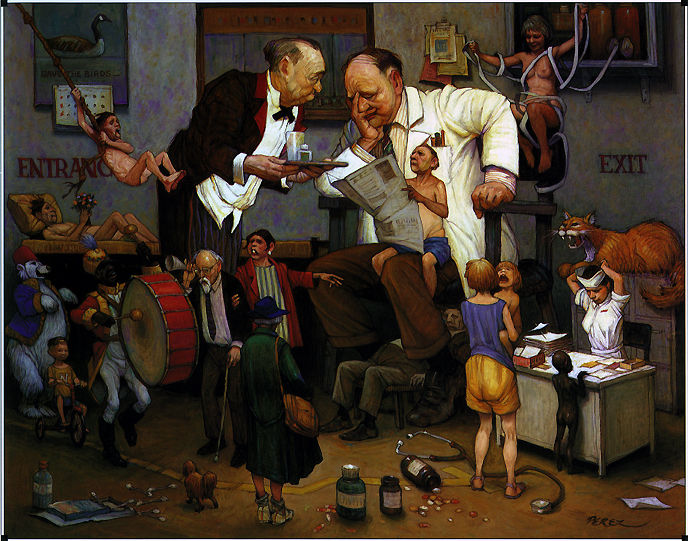
The Family Practitioner


Found this illustration via The Examining Room of Dr. Charles. I'd say it captures the feel of most family doctors' offices just right except that the tape the woman sitting behind the doctor is tangled up in should be red instead of white.

For other depictions of various medical specialties, go to this exhibition on the art of Jose Perez.

Tuesday, March 09, 2010

A Top 50 Blog!

My blog is number 35 on this list which came out a while ago and is in no particular order. Amazing, considering how infrequently I post. But I am more about quality than quantity. That is, after all, why I left seeing 24+ patients a day and now see about 4-6 patients/day in my little micropractice.

Speaking of Top 50 blogs, I notice over on the excellent DB's Medical Rants site that he is posting his monthly workout tally on his blog, I guess to hold himself accountable for his exercise regimen. Likewise, over the past few years, I have come to the realization that I need to be pushed to exercise.

Like many of you, I had my gym membership that got used for the first few months, only to languish and fall to the wayside as my schedule got busy and motivation waned.

Then a few years ago, my wife showed me this newspaper article about a trainer that can help you dunk. I thought, why not give it a try? So I called the trainer up and he has been training me ever since. I haven't dunked a basketball yet (at least not on a 10 foot rim), but I have touched the rim, something I haven't done since college. In case you're wondering, I'm only 5'9".

But I am convinced that if I keep at it, I will eventually achieve my goal and dunk. Just like I was able to establish my solo micropractice. But I still need some coaching to help get me where I want to be.

That is what we can all use sometimes, whether is is losing weight, eating better, managing time, etc. A little coaching. And a willingness to work at it.