StatCounter

Sunday, June 22, 2008

Old Fashioned Touch

From The Olympian in Washington State: "Old-fashioned touch: Micropractice helps doctor humanize modern medicine"
Dr. Marius Laumans strives to run an old-fashioned medical practice with modern-day conveniences.

Need a same-day appointment? Patients can go to his Web site, check his availability and schedule one.

Wondering if an over-the-counter allergy drug could mix poorly with prescription medication? All of Laumans' patients have his cell phone number and e-mail address and are encouraged to use them anytime.

Too sick with a stomach bug to get out of bed and drive to his office? Not to worry, he makes house calls, too.

"Thirty years ago, this was what a regular practice looked like," Laumans said.

The 34-year-old family physician is one of a growing number of doctors who are opting to go solo - without the support of receptionists, nurses, medical assistants, billing clerks and cleaning staff.

Dr. Laumans is indeed part of a growing movement of IMP (Ideal Medical Practice) doctors that seeks to improve quality of care as well as quality of life for patients and physicians alike. However, this article perpetuates the old concept of "micropractices" being completely solo-solo operations. Many IMPs start out without any employees, then add staff later as the practice grows.

And there aren't 500 micropractices/IMPs in the country...yet. But hopefully there will be. To find an IMP, go to http://www.impmap.com.

Friday, June 20, 2008

The Hopeful Future of Medicine

Image

IMP Camp 2008 is underway and full of bright-eyed and bushy-tailed (and even tail-deficient) doctors!

From Soma's blog
I had started my medical practice in Manhattan in the summer of 2006. They say if you can make it there you can make it anywhere…Oh boy is that true. I started my business before I even knew the existence of the IMP group. I didn’t realize that the same concepts and the similar reasons why I wanted to go into business for myself was why several other physicians all over the country did the same. Most of the topics at the conference are things that I have already been developing in my own business. The spirit of the people is what gives me inspiration to continue what I am doing. Some have been in business longer than I have, some work in areas that are considered to be dead-zones for effective health care. But they continue. They get over the hurdles, take every day one day at a time and remain true to their souls. The magic of this is this is something that you cannot learn in medical school. It already has to be there. And most of the people here have it.

Speaking as one of those "dead-zone" doctors, I agree with Soma's sentiments about the enthusiastic spirit and idealism of the 80+ attendees. We want to save the world, one patient at a time.

IMP Evolution

From the June 2008 issue of Medical Economics, "Small practice evolution: The medical micropractice":
Every so often, a new patient of internist Jean Antonucci in Farmington, ME, looks puzzled when the doctor herself—and not a medical assistant—walks into the waiting room and escorts him to a 125-square-foot room.

In that room, which looks out on pine trees and a stream, Antonucci takes vital signs, asks the patient what's bothering him, diagnoses and treats that problem, and collects the copay. By the time the patient leaves, he realizes that Antonucci is truly a one-woman show.

"I really don't need staff," says Antonucci, who rents the space from another physician. "I'm amazed at how well this method works."

The method is known as a micropractice, and it defies the conventional wisdom of practice management experts who urge doctors to boost their productivity by delegating nonphysician chores. A micropractice doctor typically works without employees in a space that's drastically smaller than what the average soloist has. Such austerity reduces the customary overhead by 40 to 50 percent, thereby lowering the break-even point and enabling micropractitioners to spend more time with fewer patients.

Speaking of evolution, the official name is now "Ideal Medical Practice" or IMP, and not micropractice. That's because you don't have to be solo/small to achieve ideal health care.

Tuesday, May 13, 2008

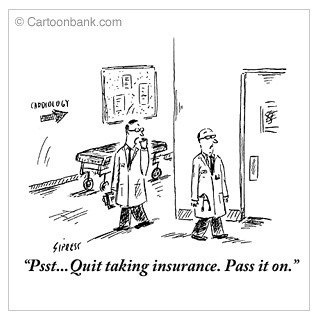
Psst!

Image

From The New Yorker Magazine

Pass it on.

Wednesday, February 13, 2008

Franco is Still Dead

From the NY Times: "Number of US Primary Care Doctors Down".
Fewer American doctors are focusing on primary care, but the decline is being covered by physicians from other countries. The General Accountability Office said Tuesday that as of 2006 there were 22,146 American doctors in residency programs in the United States specializing in primary care.

That was down from 23,801 in 1995, the research arm of Congress told the Senate Health, Education, Labor and Pensions Committee.

''It is troubling to me that the number of Americans pursuing a career in primary care has declined,'' said Sen. Bernie Sanders, I-Vt.

The Senator's solution? Doubling the funds for the National Health Service Corps. That's like trying to get people to buy a Zune by pricing it less than an iPod. Hello? It ain't gonna work with primary care either.

The only way to get more doctors going into primary care is to make the career and lifestyle *more* attractive than going into a specialty. Paying them more and abusing working them less would be a great start.

I'm not holding my breath on this one.

Tuesday, December 11, 2007

Terribly Inefficient for Society

Gerald left the following comments:
I read about your idea several years ago. Here's the deal, that bugged me from the start, and still gets to me.

While on the one hand you do spend more time with patients, and likely make better decisions, you also miss out on a crucial element of civilization. Division of labor! Why on earth do you have to waste hours at a stretch calling insurance companies yourself, or waiting for patients to fill out forms and stuff? Also, simple tasks like bp and blood draws and injections and a host of other things can be done just as effectively by a nurse. I mean, what's the point in about 11 years of education, otherwise?

Basically, it seems like there is in principle a good reason why a medical practice almost always has at least a couple of employees. Course, if you hired two people (a nurse and a receptionist/biller) then you'd have to see more patients to pay the additional overhead.

Furthermore, hiring 2 employees and so forth makes a business have a lot of overhead (which would be less if there were 2 doctors and shared staff). Also, we haven't discussed the fact that you could also do a lot more with advanced medical equipment, which costs stacks of money. Ultimately, once it is all said and done you see why the basic clinic with several doctors, shared support staff, ect is the minimum "cell size" for most medical practices.

Ultimately, it's a circular argument. I see why you do what you do, even though "in theory" it's terribly inefficient for society.


Thanks for your comments, Gerald.

First of all, I believe that one size does not fit all, and that it is OK that some people prefer doctors who answer their own phones and enjoy getting to know their patients, while other patients prefer doctors who have huge medical offices with lots of employees. Kind of like how some people prefer The Parkway Grill while others go for McDonald's. It's just food, after all, right?

Second, the more advanced medical equipment you have, the more you want to use it in order to make enough money to justify buying it in the first place. Then after you've paid it off, you want to make more "stacks of money", so that you can buy even more advanced medical equipment, which you then want to use so you can make enough money to pay for it, etc.

That is one of the premises of the book, "Overtreated: Why Too Much Medicine is Making Us Sicker and Poorer", which one of my patients told me about (thanks, RS!).
Is a CT scan always necessary after your child suffers a bump on the head? Should you think twice before undergoing surgery for lower back pain? Are your elderly parents going to be allowed to die at home, or will they spend their last few weeks in a hospital, hooked up to machines and tubes, subjected to painful, unnecessary procedures?

These are the kinds of questions you may find yourself asking once you’ve read Overtreated. Each year, our medical system delivers an enormous amount of care that does nothing to improve our health or lengthen our lives. Between 20 and 30 cents on every health care dollar we spend goes towards useless treatments and hospitalizations, towards CT scans we don’t need, towards ineffective surgeries—towards care that not only does nothing to improve our health, but that we wouldn’t want if we understood how dangerous it can be. This is the surprising and deeply counterintuitive message of Overtreated.

Of course, almost everything in our personal experience says just the opposite, that far from delivering too much care, our medical system isn’t giving us enough. Forty-seven million of us don’t have coverage, and even those of us who do have health insurance feel as if our insurers and doctors are continually trying to deny us treatments and tests and drugs that could help us.

Yet as award–winning journalist Shannon Brownlee shows in this remarkable book, much of what we think we know about health care is simply wrong. With probing insight and facinating examples, Brownlee unveils its topsy-turvy economics, where the supply of medical resources—beds, specialists, intensive care units—determines what care we receive, rather than how sick we are and what we actually need.

I have been tempted to do EKGs on otherwise healthy men and women during their physicals, just because I know that it can generate another $30 to help pay for my $2000 EKG machine. But I don't because I know there is no indication or evidence to justify it. What if I had a $35,000 DEXA scanner? You bet I would screen for osteoporosis a lot more, in women AND men.

Lastly, I wonder which of the following is the most "terribly inefficient for society", hypothetically speaking?

1. Doctors who spend 90-100% of visit time with a patient in order to get to know them better so that they can provide their patients with the medical care they want and need in an enjoyable and sustainable practice.

2. A doctor who uses 3 part-time nurses and a medical assistant to take histories, document encounters, instruct the treatment plan so that he can "see" an average of 38 patients a day, liberating him to spend an average of about 5 minutes per patient (and boosting his income by 70 percent!).

3. A healthcare system that takes money from patients, then uses 1/4 of it to pay people to do their best to give as little of the rest of the money as possible to the doctors who actually take care of patients, forcing them to hire people to waste hours at a stretch calling the first group of people who explain that they won't pay the doctor because they entered the wrong code.

4. Killing all persons with defective genes, selectively breeding people to be smarter, stronger, more resistant to disease, forcibly limiting population size so as not to overuse limited natural resources, having a central world dictatorship that eliminates all wars, famine, poverty, crime and reality TV shows. In other words, world peace.

I vote for number 3.

Congressional Order of Merit Scam

You may be getting a phone message like this in the near future (as I did a few days ago):

"My name is Carl Sibley and I'm with Congressman Tom Cole and the National Republican Congressional Committee in Washington. For your role as a business leader in California, we want to recognize you with our highest honor, the Congressional Order of Merit. I need to speak with you about it as soon as possible. Again my name is Carl Sibley and my number is 888-383-4164. Please call me as soon as you get this message. Thank you. Goodbye."

If you call back, you will be told that to get the award, you have to listen to a pre-recorded message from Rep. Cole, agree to add your name to an advisory committee, and you have to make a donation. The worst part is, there is no such award as the Congressional Order of Merit that is recognized by the US Congress. It is something made up by the National Republican Committee to raise money.

No free lunches. No free awards.

This is the kind of behavior we see from someone who is supposed to be responsible for fixing our broken healthcare system. This is how it got broken in the first place